![[community profile]](https://www.dreamwidth.org/img/silk/identity/community.png)

[psl hub]

TIMELINE
Venice, 1600s
Part 1
Key points include:
Austria, the late 19th century/early 20th
Alucard gives shitty gifts
The 1970s
If you're so unhappy, why not travel between worlds?


(no subject)
OOC INFORMATION
Player Name: Dia
Are you over 18?: Yes
Contact: PM Alucard's account
Other Characters in Game:None
IC INFORMATION

Art by Oglops on plurk, please don't redistribute as this was specifically for the game!

Character Name: Alucard/Adrian F. Tepes
Canon: Netflix Castlevania
Canon Point: End of season 3
Background: Castlevania wiki
Suitability: Note: Alucard may be coming from the end of s3, but this application from here on out will discuss s4 spoilers.
By the end of season 3, Alucard has decided that impaling corpses on the front lawn in order to protect himself from betrayal and ensure his safety is the best way to survive. In short, he takes a few steps down the road to becoming Dracula in full, and while he gets better by the conclusion of s4, the opportunity to throw Alucard into an extremely bad situation via imprisonment, dig down into the question of how much like dad are you really going to be?, and watch him process a new world where what is correct may not be readily apparent is something I am personally incredibly interested in exploring.
Based on his being summoned alone and then thrown into prison, Alucard's going to have no interest in being of service to the Kingdom of Thorne. Pushed hard enough and he might be interested in vengeance rather than simply isolation, and much of that would depend on his escaping imprisonment and reaching the Free Cities. Based on the description, it is very similar to the state of technology Alucard grew up with in the castle. That said, he might also find Nowich of interest depending on his state of depression vs. state of anger, especially with regard to the vampire population.
Much of Alucard's initial arc would be focused on exploring and choosing a side in the conflict. For me, these two things are linked and key to plot engagement, as his CR will very much impact his choice on how to engage with the war. Likewise, this will go on to define how much closer to his father's view of the world he does (or doesn't!) end up being drawn towards, and thus where his ultimate allegiance may end up lying and what he's willing to do (a lot, probably) to defend it.
Powers:
1. Superhuman strength and speed - Like any typical vampire, he can lift more and move in the blink of an eye
2. Rapid healing - Save from blows from silver or seemingly Dracula, Alucard can heal quickly and endure what would be bone shattering blows on anyone else
3. Levitation - he can float for no reason other than dramatics
4. Wolf shifting - He can become a large white, fluffy wolf.
5. Fighting abilities - Alucard is a highly effective swordsman and can manage very well at hand to hand as well.
6. He can control his sword with his mind - Seriously. He can. He can make it float away from him and still control it, the whole thing is needlessly extra.
7. Perfect hair at all times.
8. Extended fangs and nails - Alucard's fangs can extend and grow larger. His nails can do the same, and can scratch new markings into metal.
9. A series of bats - In addition to turning into a wolf, Alucard can become a number of bats, about ten to twenty in number.
PERSONALITY QUESTIONS
Describe an important event in your character's life and how it impacted them. The murder of Lisa, Alucard's mother is the key event for not only the entire video game franchise, but also Alucard's entire life. By all implications, while Alucard's childhood was weird (he specifically mentions physically growing very quickly), it was also a generally pleasant one with parents who loved each other and him. His mother in particular was well known for her medical abilities, being generally successful in that line of work thanks to Dracula's centuries of knowledge and her own natural charisma. It was her success as a physician that caused the village's former wise woman and healer to inform the church that Lisa was a witch, eventually leading to her imprisonment and murder in Targoviste.
It would have been bad enough to lose his mother in such a horrifying way, but Dracula's rage and inability to grieve like a normal person made it so much worse. Rather than simply murder the priest who oversaw the trial and execution (as per Alucard's suggestion, as he saw that anger as justified), Dracula decided to destroy all of Wallachia instead, summoning an army from Hell to wreck the country and ensure no trace of humanity remained upon the land. That was the moment Alucard accepted that for the betterment of humanity and in accordance with what his mother would want, his father could not live. In understanding that, and eventually seeing it through, Alucard took on the weight of not only destroying his remaining family, but wrecking his own home, creating a massive vampire power vacuum, and (thankfully) making a whole two friends along the way. The grief and needing to heal from all of it has lingered with him the most through the series, impacting many of his choices.
Does your character have a moral code, or other set of standards they try to live by? Yes. Alucard's moral code is built on justice and responsibility. Some of it is eye-for-an-eye, such as when Alucard understands his father's anger and advises killing the priest responsible for starting the whole thing and overseeing Lisa's execution. What he also understands is that blaming all of humanity and going down a path of destruction is disproportionate, and also not going to help his father's grief. As a result, Alucard tries to fight his father about this. This results in a grievous wound that sends Alucard to hide under Gresit for a year to recover. Once reawakened by Trevor and Sypha, the dhampir takes responsibility for what has to happen next: Dracula needs to die, and he is going to have to be the one to do it. That it will deprive him of his last family member is irrelevant - he failed to stop this once, and his mother would be aghast at what has happened in her name. He has to correct that.
Season three carries through that sense of responsibility, but in another manner. When Sumi and Taka arrive, they explain the cruel vampire circumstances they escaped from and their hopes to free their people. Alucard, having been gifted the Belmont Hold of centuries of vampire hunting lore, lets them access it, imagining Trevor would approve of the move. He wants to use the gift responsibly and in accordance with what he thinks would be wanted by someone who is absent. Unfortunately Sumi and Taka attempt to murder Alucard, and while he kills in self defense, the fact he goes so far as to impale their bodies on the front lawn shows a warped code threatened to become closer to Dracula's than Alucard's firm stances in season 1 and 2. In grief and in fear, he has to adjust his code to prioritize his own survival.
When season four opens, a few other corpses have joined those initial two. However, the arrival of a dead rider on a horse bearing a message begging for help slowly inches Alucard back towards where he was in seasons 1 and 2. He buries not only that body, out of respect for the man's attempt and willingness to give his life to save others, but the impaled bodies on the lawn. The rest of season 4 works through this warping of his own code, albeit at a speed run's pace.
What quality or qualities do they admire most? The people Alucard surrounds himself with are the best reflections of the traits he admires most: resourcefulness, honesty, and dragging him out of his own headspace.
So far as resourcefulness goes, this is on full display in season two. While he and Trevor do not exactly get along, Alucard understands what Trevor brings to the table, either as a lucky drunk or the last son of a warrior dynasty. The fact that Trevor also happens to be sitting on the greatest resource in the world to defeat Dracula - his family's Hold, the personal archives and object collection of the Belmont family - likewise reinforces this. That Sypha can then look at the material within and use her natural skills with magic and language to quickly synthesize a spell to lock onto the castle and draw it to them (even if she lands it a little too close and that's a Problem) likewise reinforces how much he values this. Alucard's picked two absolute powerhouses to help save the world with (even if there's doubt, see the question below), and the fact that they are able to use their skills in wonderful, unexpected ways is incredibly important both in getting to the castle, and in defeating Dracula and the threats that come after.
Honesty - be it in the form of Sypha threatening to set Alucard's hair on fire or Greta calling total bullshit on dramatic entrances - is important for Alucard both in finding allies and looking after his own well being (see paragraph below.) In first speaking to Trevor and Sypha regarding the legend of the sleeping solider (which drew Sypha into the sewers of Gresit to essentially find Alucard), he asks less after the legend and more after how the two view the state of the world. Both answers are frank, and for him that is good enough in order to proceed in defeating his father with the two. Journeying together helps to use that basis of honesty to build up enough trust to proceed in the deed, although Alucard's own honesty fails him when the two leave at the conclusion of season two. Left alone, Alucard makes depression dolls of the two and even goes so far as to voice them, failing his own value check in that regard. When faced with Greta in season four, she is blunt and frank with him, forcing down walls that Alucard built up in order to protect himself emotionally. That last part is important, as it highlights another highly Alucard specific value - pulling him out of his own head.
In season two, even as he was going to commit patricide, the comradery and chemistry between himself, Sypha, and Trevor became an important form of support as the moment drew closer. While much of it took the form of the three of them prodding and poking at each other, there were also moments of checking in, like Sypha ensuring that Alucard was ready to storm the castle. Likewise in season four, Greta's refusal to permit Alucard's flashy style and temporary help over something more substantial (because he was clearly going to just do that and leave, she could read him almost instantly) proves important. In staying, Alucard's able to start to work through his trauma and emotional issues rather than simply dwelling on all of it, as he would have if he remained in the castle.
Do they have a part of themselves they dislike? Alucard likes to project an exterior of being cool, calm, confident, and in control. To the point where by season four, people are not impressed by this as a flashy entrance, but can correctly read it as masking insecurities and issues that have been on display for four seasons.
The first part of himself that Alucard dislikes is one he didn't even realize at first. In season two, Sypha refers to Alucard as too cold and sad to get close to. The camera focuses on his overhearing the comment, and the reaction makes it clear that this is not only new information to him, but hurtful information as well. In season three there is a marked attempt to be more outgoing to a certain extent (or at least to better mask that sadness), but this ends with a near death experience.
Emotions, specifically not being great at them, is another huge part of what Alucard dislikes about himself. The same cool, calm sense of self he wants to project means that he is not great at emotional responses - he can't control them - and they result in extremes. While they don't go so far as I'm grieving so I'm going to destroy all of Wallachia, impaling corpses in a fit of extreme emotion isn't exactly the sign of someone in control.
Likewise, when having these emotions, Alucard projects the issues. With aforementioned corpses, Alucard makes explicit reference to his father, suggesting that this isn't an out of control emotional issue, just a response that he's following. (Obviously this is not a good thing either.) In both seasons two and four, he also projects his issues on Trevor. Sypha correctly calls out Alucard's fear in making the wrong choice about who to destroy Dracula alongside as taking the form of Alucard needling Trevor again and again, and just worsening things. In season four, in dealing with the lingering trauma of Sumi and Taka's betrayal, trying to do the right thing, and dealing with suddenly letting an army of refugees into the house again, Alucard declares that he's simply becoming Trevor, rather than owning up to the fact that he's in a bad place emotionally and needs to own that.
What is their sign, and why? The Hierophant's emphasis on an individual's moral values aligns well with Alucard's character and the moment in season 4 that eventually draws him out of behaving like his father. Alucard was raised with his mother's emphasis on hospitality, doing the right thing, and doing the greatest good no matter what - even if it involves patricide. The greatest good is burying the dead man who gave his life trying to seek your help, in spite of the impaled corpses on your lawn. The correct and just thing is important no matter what, and a core part of Alucard's character.
SAMPLES & ARRIVAL
Samples: TDM 1 | TDM 2
Arrival Scenario: Imprisonment
Player Name: Dia
Are you over 18?: Yes
Contact: PM Alucard's account
Other Characters in Game:None
IC INFORMATION
Art by Oglops on plurk, please don't redistribute as this was specifically for the game!
Character Name: Alucard/Adrian F. Tepes
Canon: Netflix Castlevania
Canon Point: End of season 3
Background: Castlevania wiki
Suitability: Note: Alucard may be coming from the end of s3, but this application from here on out will discuss s4 spoilers.
By the end of season 3, Alucard has decided that impaling corpses on the front lawn in order to protect himself from betrayal and ensure his safety is the best way to survive. In short, he takes a few steps down the road to becoming Dracula in full, and while he gets better by the conclusion of s4, the opportunity to throw Alucard into an extremely bad situation via imprisonment, dig down into the question of how much like dad are you really going to be?, and watch him process a new world where what is correct may not be readily apparent is something I am personally incredibly interested in exploring.
Based on his being summoned alone and then thrown into prison, Alucard's going to have no interest in being of service to the Kingdom of Thorne. Pushed hard enough and he might be interested in vengeance rather than simply isolation, and much of that would depend on his escaping imprisonment and reaching the Free Cities. Based on the description, it is very similar to the state of technology Alucard grew up with in the castle. That said, he might also find Nowich of interest depending on his state of depression vs. state of anger, especially with regard to the vampire population.
Much of Alucard's initial arc would be focused on exploring and choosing a side in the conflict. For me, these two things are linked and key to plot engagement, as his CR will very much impact his choice on how to engage with the war. Likewise, this will go on to define how much closer to his father's view of the world he does (or doesn't!) end up being drawn towards, and thus where his ultimate allegiance may end up lying and what he's willing to do (a lot, probably) to defend it.
Powers:
1. Superhuman strength and speed - Like any typical vampire, he can lift more and move in the blink of an eye
2. Rapid healing - Save from blows from silver or seemingly Dracula, Alucard can heal quickly and endure what would be bone shattering blows on anyone else
3. Levitation - he can float for no reason other than dramatics
4. Wolf shifting - He can become a large white, fluffy wolf.
5. Fighting abilities - Alucard is a highly effective swordsman and can manage very well at hand to hand as well.
6. He can control his sword with his mind - Seriously. He can. He can make it float away from him and still control it, the whole thing is needlessly extra.
7. Perfect hair at all times.
8. Extended fangs and nails - Alucard's fangs can extend and grow larger. His nails can do the same, and can scratch new markings into metal.
9. A series of bats - In addition to turning into a wolf, Alucard can become a number of bats, about ten to twenty in number.
PERSONALITY QUESTIONS
Describe an important event in your character's life and how it impacted them. The murder of Lisa, Alucard's mother is the key event for not only the entire video game franchise, but also Alucard's entire life. By all implications, while Alucard's childhood was weird (he specifically mentions physically growing very quickly), it was also a generally pleasant one with parents who loved each other and him. His mother in particular was well known for her medical abilities, being generally successful in that line of work thanks to Dracula's centuries of knowledge and her own natural charisma. It was her success as a physician that caused the village's former wise woman and healer to inform the church that Lisa was a witch, eventually leading to her imprisonment and murder in Targoviste.
It would have been bad enough to lose his mother in such a horrifying way, but Dracula's rage and inability to grieve like a normal person made it so much worse. Rather than simply murder the priest who oversaw the trial and execution (as per Alucard's suggestion, as he saw that anger as justified), Dracula decided to destroy all of Wallachia instead, summoning an army from Hell to wreck the country and ensure no trace of humanity remained upon the land. That was the moment Alucard accepted that for the betterment of humanity and in accordance with what his mother would want, his father could not live. In understanding that, and eventually seeing it through, Alucard took on the weight of not only destroying his remaining family, but wrecking his own home, creating a massive vampire power vacuum, and (thankfully) making a whole two friends along the way. The grief and needing to heal from all of it has lingered with him the most through the series, impacting many of his choices.
Does your character have a moral code, or other set of standards they try to live by? Yes. Alucard's moral code is built on justice and responsibility. Some of it is eye-for-an-eye, such as when Alucard understands his father's anger and advises killing the priest responsible for starting the whole thing and overseeing Lisa's execution. What he also understands is that blaming all of humanity and going down a path of destruction is disproportionate, and also not going to help his father's grief. As a result, Alucard tries to fight his father about this. This results in a grievous wound that sends Alucard to hide under Gresit for a year to recover. Once reawakened by Trevor and Sypha, the dhampir takes responsibility for what has to happen next: Dracula needs to die, and he is going to have to be the one to do it. That it will deprive him of his last family member is irrelevant - he failed to stop this once, and his mother would be aghast at what has happened in her name. He has to correct that.
Season three carries through that sense of responsibility, but in another manner. When Sumi and Taka arrive, they explain the cruel vampire circumstances they escaped from and their hopes to free their people. Alucard, having been gifted the Belmont Hold of centuries of vampire hunting lore, lets them access it, imagining Trevor would approve of the move. He wants to use the gift responsibly and in accordance with what he thinks would be wanted by someone who is absent. Unfortunately Sumi and Taka attempt to murder Alucard, and while he kills in self defense, the fact he goes so far as to impale their bodies on the front lawn shows a warped code threatened to become closer to Dracula's than Alucard's firm stances in season 1 and 2. In grief and in fear, he has to adjust his code to prioritize his own survival.
When season four opens, a few other corpses have joined those initial two. However, the arrival of a dead rider on a horse bearing a message begging for help slowly inches Alucard back towards where he was in seasons 1 and 2. He buries not only that body, out of respect for the man's attempt and willingness to give his life to save others, but the impaled bodies on the lawn. The rest of season 4 works through this warping of his own code, albeit at a speed run's pace.
What quality or qualities do they admire most? The people Alucard surrounds himself with are the best reflections of the traits he admires most: resourcefulness, honesty, and dragging him out of his own headspace.
So far as resourcefulness goes, this is on full display in season two. While he and Trevor do not exactly get along, Alucard understands what Trevor brings to the table, either as a lucky drunk or the last son of a warrior dynasty. The fact that Trevor also happens to be sitting on the greatest resource in the world to defeat Dracula - his family's Hold, the personal archives and object collection of the Belmont family - likewise reinforces this. That Sypha can then look at the material within and use her natural skills with magic and language to quickly synthesize a spell to lock onto the castle and draw it to them (even if she lands it a little too close and that's a Problem) likewise reinforces how much he values this. Alucard's picked two absolute powerhouses to help save the world with (even if there's doubt, see the question below), and the fact that they are able to use their skills in wonderful, unexpected ways is incredibly important both in getting to the castle, and in defeating Dracula and the threats that come after.
Honesty - be it in the form of Sypha threatening to set Alucard's hair on fire or Greta calling total bullshit on dramatic entrances - is important for Alucard both in finding allies and looking after his own well being (see paragraph below.) In first speaking to Trevor and Sypha regarding the legend of the sleeping solider (which drew Sypha into the sewers of Gresit to essentially find Alucard), he asks less after the legend and more after how the two view the state of the world. Both answers are frank, and for him that is good enough in order to proceed in defeating his father with the two. Journeying together helps to use that basis of honesty to build up enough trust to proceed in the deed, although Alucard's own honesty fails him when the two leave at the conclusion of season two. Left alone, Alucard makes depression dolls of the two and even goes so far as to voice them, failing his own value check in that regard. When faced with Greta in season four, she is blunt and frank with him, forcing down walls that Alucard built up in order to protect himself emotionally. That last part is important, as it highlights another highly Alucard specific value - pulling him out of his own head.
In season two, even as he was going to commit patricide, the comradery and chemistry between himself, Sypha, and Trevor became an important form of support as the moment drew closer. While much of it took the form of the three of them prodding and poking at each other, there were also moments of checking in, like Sypha ensuring that Alucard was ready to storm the castle. Likewise in season four, Greta's refusal to permit Alucard's flashy style and temporary help over something more substantial (because he was clearly going to just do that and leave, she could read him almost instantly) proves important. In staying, Alucard's able to start to work through his trauma and emotional issues rather than simply dwelling on all of it, as he would have if he remained in the castle.
Do they have a part of themselves they dislike? Alucard likes to project an exterior of being cool, calm, confident, and in control. To the point where by season four, people are not impressed by this as a flashy entrance, but can correctly read it as masking insecurities and issues that have been on display for four seasons.
The first part of himself that Alucard dislikes is one he didn't even realize at first. In season two, Sypha refers to Alucard as too cold and sad to get close to. The camera focuses on his overhearing the comment, and the reaction makes it clear that this is not only new information to him, but hurtful information as well. In season three there is a marked attempt to be more outgoing to a certain extent (or at least to better mask that sadness), but this ends with a near death experience.
Emotions, specifically not being great at them, is another huge part of what Alucard dislikes about himself. The same cool, calm sense of self he wants to project means that he is not great at emotional responses - he can't control them - and they result in extremes. While they don't go so far as I'm grieving so I'm going to destroy all of Wallachia, impaling corpses in a fit of extreme emotion isn't exactly the sign of someone in control.
Likewise, when having these emotions, Alucard projects the issues. With aforementioned corpses, Alucard makes explicit reference to his father, suggesting that this isn't an out of control emotional issue, just a response that he's following. (Obviously this is not a good thing either.) In both seasons two and four, he also projects his issues on Trevor. Sypha correctly calls out Alucard's fear in making the wrong choice about who to destroy Dracula alongside as taking the form of Alucard needling Trevor again and again, and just worsening things. In season four, in dealing with the lingering trauma of Sumi and Taka's betrayal, trying to do the right thing, and dealing with suddenly letting an army of refugees into the house again, Alucard declares that he's simply becoming Trevor, rather than owning up to the fact that he's in a bad place emotionally and needs to own that.
What is their sign, and why? The Hierophant's emphasis on an individual's moral values aligns well with Alucard's character and the moment in season 4 that eventually draws him out of behaving like his father. Alucard was raised with his mother's emphasis on hospitality, doing the right thing, and doing the greatest good no matter what - even if it involves patricide. The greatest good is burying the dead man who gave his life trying to seek your help, in spite of the impaled corpses on your lawn. The correct and just thing is important no matter what, and a core part of Alucard's character.
SAMPLES & ARRIVAL
Samples: TDM 1 | TDM 2
Arrival Scenario: Imprisonment
(no subject)
PLAYER INFO
Name: Dia
Age: Over 21
Contact: PM
Current Characters: n/a
CHARACTER INFO
Name: Alucard
Journal:![[personal profile]](https://www.dreamwidth.org/img/silk/identity/user.png) cryptsleeper
cryptsleeper
Age: Physically in his mid 20s, as of canon, exactly 20
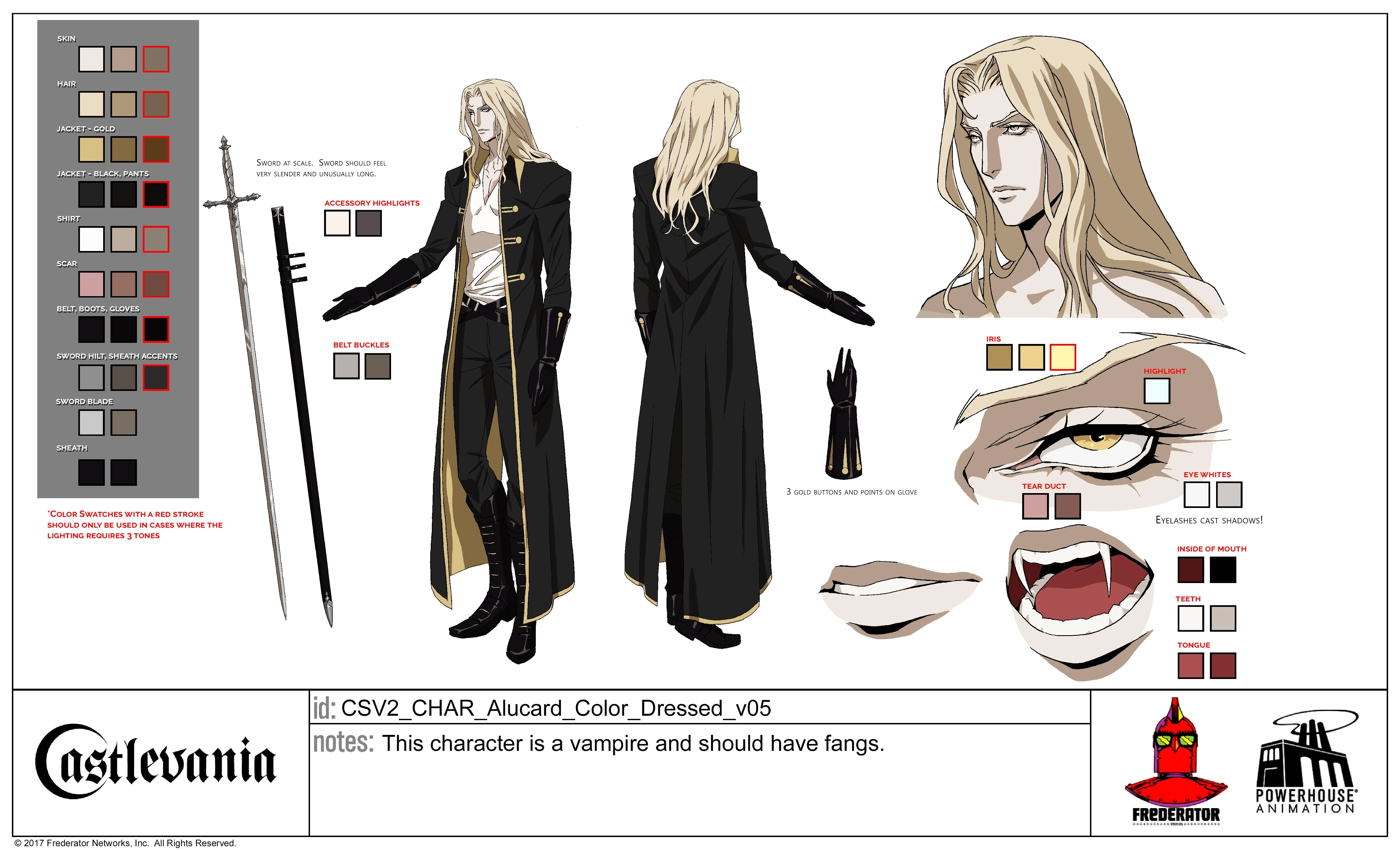
Appearance: Design sheet | In action
Canon: Netflix Castlevania
Canon Point: End of s3
History: Fandom wiki
Abilities:
1. Superhuman strength and speed - Like any typical vampire, he can lift more and move in the blink of an eye
2. Rapid healing - Save from blows from silver or seemingly Dracula, Alucard can heal quickly and endure what would be boneshattering blows on anyone else
3. Levitation - he can float for no reason other than dramatics
4. Wolf shifting - He can become a large white, fluffy wolf.
5. Fighting abilities - Alucard is a highly effective swordsman and can manage very well at hand to hand as well.
6. He can control his sword with is mind - Seriously. He can. He can make it float away from him and still control it, the whole thing is needlessly extra.
7. Perfect hair at all times.
8. Extended fangs and nails - Alucard's fangs can extend and grow larger. His nails can do the same, and can scratch new markings into metal.
Questionnaire:
Samples: Sample 1 Sample 2 Sample 3
Why are you interested in this game? Season 3 ends with Alucard betrayed emotionally and following in his father's footsteps by impaling corpses on the lawn. This is not a very easy situation to enter a game into under most circumstances, but it is a potentially fascinating thing to play out. Due to Polymytho's premise and emphasis on change and interrogation of oneself, it is an ideal space to explore the darker impulses of Alucard and Dracula's darker legacy over him in a way I don't think I could in any other space.
Name: Dia
Age: Over 21
Contact: PM
Current Characters: n/a
CHARACTER INFO
Name: Alucard
Journal:
cryptsleeperAge: Physically in his mid 20s, as of canon, exactly 20
Appearance: Design sheet | In action
Canon: Netflix Castlevania
Canon Point: End of s3
History: Fandom wiki
Abilities:
1. Superhuman strength and speed - Like any typical vampire, he can lift more and move in the blink of an eye
2. Rapid healing - Save from blows from silver or seemingly Dracula, Alucard can heal quickly and endure what would be boneshattering blows on anyone else
3. Levitation - he can float for no reason other than dramatics
4. Wolf shifting - He can become a large white, fluffy wolf.
5. Fighting abilities - Alucard is a highly effective swordsman and can manage very well at hand to hand as well.
6. He can control his sword with is mind - Seriously. He can. He can make it float away from him and still control it, the whole thing is needlessly extra.
7. Perfect hair at all times.
8. Extended fangs and nails - Alucard's fangs can extend and grow larger. His nails can do the same, and can scratch new markings into metal.
Questionnaire:
1. What do they care deeply about? What kind of loyalties, commitments, moral codes, life philosophies, passions, callings or spirituality and faith do they have? How do these tend to be expressed? Seasons one and two of Castlevania make Alucard's moral code clear: he is a man of justice and a man of responsibility. In reacting to his mother's murder, he understands Dracula's reaction and advises killing the priest responsible for inciting the whole thing rather than all of humanity, as that is fair and correct for what has come to pass. To blame the world is wildly incorrect, and when his father fails to listen, Alucard makes it clear that he will fight Dracula about this. What results is Alucard's near death, and he retreats and recovers for a full year. When he is reawakened by Trevor and Sypha, the dhampir takes responsibility for what has to happen next: Dracula needs to die, and he is going to have to be the one to do it. That it will deprive him of his last family member is irrelevant - he failed to stop this once, and his mother would be aghast at what has happened in her name. He has to correct that.
Season three carries through that sense of responsibility, but in another manner. When Sumi and Taka arrive, they explain the cruel vampire circumstances they escaped from and their hopes to free their people. Alucard, having been gifted the Belmont Hold of centuries of vampire hunting lore, lets them access it, imagining Trevor would approve of the move. Sumi and Taka also allow Alucard's sense of hospitality to shine through, as he provides clothing, shelter, and even cooks for them. Given that his mother Lisa once berated Dracula for failing to be remotely welcoming, it is likely that this trait was learned from her.
Unfortunately by the end of season three, these codes show signs of warping and conforming closer to Dracula's moral code of being alone, keeping the world at bay, and justice being punitive rather than measured and fair. In response to a murder attempt, Alucard is not content enough with simply dispatching his would be dispatchers, but he impales the corpses of Sumi and Taka on the lawn, as his father once did.
2. What kind of person could they become in the future? What are some developmental paths that they could take: best, worst, most likely?
As season three's conclusion might have you believe, Alucard's worst version of himself is a version of his father. Impaled corpses on the lawn, holed up away in a castle, and lashing out at the world as it tries to encroach further upon him. He's been betrayed by people he's trusted and almost murdered, he's been left alone in the wreck of his home where he murdered his father, and the whole situation would be enough to drive anyone to a bad, dark place. If season three had no follow up, then this would be a logical place to think the dhampir might be.
The best version of Alucard would be a man who could forgive himself for the patricide he did for the good of the world, who could trust others easily and provide access to his home and the Belmont Hold with no issues, and who might have a twinge of sadness to him. Moreover and most importantly, he could communicate his real emotional needs, instead of downplaying them or hiding them behind an impossible wall of ice.
In the end though, the most likely path for Alucard centers around guilt, forgiveness, and how he chooses to interact with the world. He may not ever fully permit himself to be free of the guilt from having to kill his father or the subsequent aftermath and power vacuum it created, but he's able to function with that weight. Going out into the world though? That may be a step too far, due to a lingering mistrust and a desire to be apart. With enough time spent bonding with people who he can trust though, Alucard can likely be better at expressing his emotional needs, melting the ice wall he hides behind just enough.
3. How do they behave within a group? What role(s) do they take? Does this differ if they know and trust the group, versus finding themselves in a group of strangers? Why?
Alucard's most extensive group experience is defined by his time with Trevor and Sypha. Although they were drawn together by a prophecy regarding Dracula's defeat, the particulars of their roles were not especially refined. Sypha forms the emotional core of the group as well as being the magic user, far better socialized and empathetic. Trevor represents a strategic mind, but both he and Alucard share a does not play well with others personality due to their respective isolation. Alucard acts as the primary muscle, capable of working with Trevor's planning and Sypha's skill. The trio's ability to work together and function as a coherent whole is a massive element of season two, and it ends with the three of them not only defeating Dracula, but being capable of providing emotional support. Alucard does not shrug off the empathy or gestures from either of them as he might have done earlier in the season, but his desire to still keep himself apart means that Sypha and Trevor leave him alone in a ruined castle.
A similar approach plays out with Sumi and Taka upon their arrival, especially as they make to attack Alucard first. However when they explain their circumstances, and given that Alucard has had an overall positive experience with group work in the past, he is more trusting of the two and allows them into his home. While not all of the castle's secrets are revealed and Alucard keeps some things close to his chest, he is generally more open and personable until it all goes so very wrong.
In short, Alucard doesn't trust people off the bat and tends to play things close to his chest. When trust is earned, he is capable of responding in a more genuine and less guarded manner. The amount of work required to gain that trust varies.
4. What do they need and want out of relationships, and how do they go about getting it?
Alucard is still learning to relationship in many ways, as canon doesn't elaborate much on if he grew up with friends or with much interaction with the human world. Based on the fact he missed Trevor and Sypha enough to make horrifying dolls of them and imitate their voices, and on what he had with Sumi and Taka before the murder attempt, a few things can be determined.
Most of all, Alucard really needs some sort of purpose. With Dracula defeated but no one else in the big castle with him, he's not only lonely but aimless and losing track of days. With Sumi and Taka present and asking to learn from him, Alucard's general demeanor brightens considerably, and he doesn't only relish the company but he relishes the chance to do something constructive.
Related is his need for companionship. The Trevor and Sypha dolls are enough to prove that relationships of any stripe help to stave off loneliness and depression for him, and the violent end of season three serves to underscore a simple point. Alucard does not do well when left alone.
To get any of this, Alucard's approach is to be as giving and trusting as he can be, showing what can either be seen as naiveté or a real approach to no longer be the ice well Sypha sees in season two. Not only does he go out of the way to give shelter, cook, and offer conversation with his guests, but he's frank while being just cautious enough to not dig into painful recent memories. That he lets Sumi and Taka take him to bed is a sign that this works, but then it all crashes down.
5. How do they understand the world–what kind of worldview and thought processes do they have? Why?
Alucard's world view is best understood in looking at the end of season two, when he is given the custody of the Belmont Hold by Trevor. Approaching Sypha and Trevor, he admits that his first instinct after defeating his father was to return to a deep sleep in his personal crypt under the city of Gresit, away from the world. With the castle exposed to the world instead, he plans to guard it, but sees it as a tomb - one whose responsibility and stewardship he will now take over. At that point, Trevor gives Alucard custody of the Hold as well, making a point of tying together Alucard's vampire and human heritage and to treat it as collection of knowledge to be shared, rather than a place of death. The fact that Alucard still intendents to be apart from others doesn't garner comment, but it does make a point: Alucard sees himself as between worlds, but not fully existing in either. He is meant to keep the Night World at the borders, and that is because he has the skills to navigate it. This thought process is also a self-punishment and means of dealing with the guilt of having committed patricide.
6. How much do they rely on their minds and intellect, versus other approaches like relying on instinct, intuition, faith and spirituality, or emotions? Alucard balances instinct and intellect, using both as appropriate but having little interest in faith and spirituality. Being raised by a polymath of a father and a doctor of a mother, Alucard has had access to information that the rest of humanity won't know for centuries to come. The castle he grew up with had electric lights, and in building his own private crypt, Alucard was able to copy almost all of the technology present in his childhood home. Alucard knows how to plan, and while he isn't the strategist Trevor is, he isn't slacking in the department either.
In physical fights, Alucard is all instinct, but that comes from experience and his abilities. (See above.) He does well in a fight, capable of reacting automatically, and he is typically successful in most brawls in the series.
Fighting is about where anything like instinct and intuition falls off. Given that his father is viewed as the bane of humanity and his mother was murdered by the Church, spirituality holds little interest for Alucard. Growing up in fairly isolated circumstances, Alucard also has growing to do emotionally, as he can be childish about his own issues (see question 7).
7. What is something others might find intolerable about them? When Alucard is insecure, he will lash out at others to try and regain his confidence. This is shown in season two with his regard for Trevor, as they spend most of the season sniping at each other over absolutely nothing. When Alucard proceeds to comment to Sypha that she's spending too much time enjoying Trevor's company, she correctly calls the dhampir out that he's worried he chose wrong, that he's going to fail, and that he is acting like a child for behaving in this way. For how Alucard tries to carry himself as a mature adult, it's a blow, but also incredibly accurate and astute.
Samples: Sample 1 Sample 2 Sample 3
Why are you interested in this game? Season 3 ends with Alucard betrayed emotionally and following in his father's footsteps by impaling corpses on the lawn. This is not a very easy situation to enter a game into under most circumstances, but it is a potentially fascinating thing to play out. Due to Polymytho's premise and emphasis on change and interrogation of oneself, it is an ideal space to explore the darker impulses of Alucard and Dracula's darker legacy over him in a way I don't think I could in any other space.
(no subject)
Player Information
Name: Dia
Age: Over 21
Contact: PM preferred
Other Characters: n/a
Character Information
Name: Alucard
Canon: Castlevania (Netflix anime)
Canon Point: End of S2
Age: 20ish, according to canon
History: Castlevania wiki
Or the extreme tl;dr version: Dracula, who is also dad, tries to destroy Wallachia in a fit of grief after Lisa (mom) is executed under false accusations of witchcraft. Alucard attempts to not make that happen, is attacked, spends a year in recovery, then finds two friends to help commit a patricide! Oh, said friends are a magician of ridiculous power and the last son of a family dedicated to murdering Dracula. As you do.
Personality:
⤛Lonely: Sypha calls this one out explicitly in canon, comparing Alucard to a cold spot in a room, impossible to break through. Alucard's dealt with the extremely upsetting death of his mother being burned at the stake and then having to kill his own father, but that loneliness was there before all those things happened. Netflix canon declines to say if Alucard had friends or much contact with the world outside the castle, but it is likely that the answer is "he did not."
⤛Aloof: The loneliness mentioned above feeds into a certain sense of aloofness that Alucard has. Other parts of the Castlevania franchise mention that Alucard holds the world at arm's length due to his heritage, being of two worlds but fitting into neither. In Netflix canon, this is true especially as the trio enter the Belmont Hold, and Alucard has to process the fact that much of the hold's contents are related to the destruction of individuals such as himself.
⤛Strong moral compass and sense of responsibility: There is in Alucard a very strong understanding of right and wrong, although maybe it's low hanging fruit for anyone to say "hey, don't commit genocide out of grief?" What gives greater credence to his moral compass is how it couples to the fact he is a responsible dhampir. It would be so easy to leave the destruction of Dracula to anyone else, but it is Alucard who feels that he must be the one who brings down his father and all the madness that Dracula's grief has brought down upon Wallachia.
⤛Witty bordering on jackassery: One of the major traits in all three of the main Castlevania trio is their quick wit and ability to bounce off of each other. In the case of both Alucard and Trevor there is a very bad tendency for the wit to slam into taking things a step too far and just saying something hurtful/being an asshole.
⤛Intelligent: He says it himself, "my mother was a doctor and my father was a polymath." It crops up in little ways in determining courses of action and strategic moves, and in big ones. In particular, Alucard's quick repair of a viewing mirror by knowing the Chaldeic language is one of the prerequisites needed to finally lock down Dracula's moving castle.
⤛Dutiful: Alucard's a good son, and that's important. He makes a comment about how all are slaves to family desires in Castlevania in a way that sounds as if he would rather do anything else, but he does what it is his mother would have wanted in the end. That includes destroying the ultimate threat to humanity in the form of his father, despite the fact that it means causing himself more grief.
Abilities & Skills:
Abilities
⤛Understanding of magic and some ability to use it, kind of, urgh: Netflix canon makes it unclear Alucard's exact level of skill with magic (he is shown to be skilled enough to not only identify a magic object but repair it by re-etching the appropriate letters; he also has his own crypt that is a smaller, less advanced version of Dracula's moving castle). The video games simply state that he's about half as powerful as his father, with the canon wiki for the games citing skills like Hellfire and the fact he can seemingly change his identity. Until s3 happens and clarifies this, the point is unfortunately vague.
⤛Levitation/floating: Castlevania vampires and dhampirs can float, mostly because a) why not b) yelling "bat fight" is fun and c) Trevor Belmont has to make floating vampire Jesus jokes at some point in time.
⤛Superhuman strength and speed: Exactly what it says on the tin. Dhampir and vampires can move fast and knock shit around with alarmingly destructive results.
⤛Regeneration: If you cut him, he heals very quickly.
⤛Shapeshifting: He can turn into a large white wolf.
⤛Telekinesis: Alucard can move his sword with his mind, for bullshit reasons like "my dad can" and "it looks cool."
Practiced Skills
⤛Extraordinarily skilled at hand-to-hand combat
⤛Likewise skilled in swordsmanship with his weapon of choice being a longsword.
⤛Intelligent, as he is the son of two scientists and has access to a knowledge far beyond that of anyone else in medieval Wallachia
Inventory/Companions:
--His clothes (white shirt, black trousers, sort of extra coat, leather gloves)
--Sword
Choice: Witch
Reason: When your mother is executed on accusations of witchcraft (when she was just being a good scientist with an advanced understanding of medicine), you are very much bound to have emotions. Likewise, befriending a spellcaster/magician such as Sypha also brings about strong emotion. Going the witch route is an excellent way to explore the grief and long lasting emotions tied to what's come to pass in canon
Sample: With Geralt on the TDM | With Ursula on the TDM | General character work with a Leon Belmont
Name: Dia
Age: Over 21
Contact: PM preferred
Other Characters: n/a
Character Information
Name: Alucard
Canon: Castlevania (Netflix anime)
Canon Point: End of S2
Age: 20ish, according to canon
History: Castlevania wiki
Or the extreme tl;dr version: Dracula, who is also dad, tries to destroy Wallachia in a fit of grief after Lisa (mom) is executed under false accusations of witchcraft. Alucard attempts to not make that happen, is attacked, spends a year in recovery, then finds two friends to help commit a patricide! Oh, said friends are a magician of ridiculous power and the last son of a family dedicated to murdering Dracula. As you do.
Personality:
⤛Lonely: Sypha calls this one out explicitly in canon, comparing Alucard to a cold spot in a room, impossible to break through. Alucard's dealt with the extremely upsetting death of his mother being burned at the stake and then having to kill his own father, but that loneliness was there before all those things happened. Netflix canon declines to say if Alucard had friends or much contact with the world outside the castle, but it is likely that the answer is "he did not."
⤛Aloof: The loneliness mentioned above feeds into a certain sense of aloofness that Alucard has. Other parts of the Castlevania franchise mention that Alucard holds the world at arm's length due to his heritage, being of two worlds but fitting into neither. In Netflix canon, this is true especially as the trio enter the Belmont Hold, and Alucard has to process the fact that much of the hold's contents are related to the destruction of individuals such as himself.
⤛Strong moral compass and sense of responsibility: There is in Alucard a very strong understanding of right and wrong, although maybe it's low hanging fruit for anyone to say "hey, don't commit genocide out of grief?" What gives greater credence to his moral compass is how it couples to the fact he is a responsible dhampir. It would be so easy to leave the destruction of Dracula to anyone else, but it is Alucard who feels that he must be the one who brings down his father and all the madness that Dracula's grief has brought down upon Wallachia.
⤛Witty bordering on jackassery: One of the major traits in all three of the main Castlevania trio is their quick wit and ability to bounce off of each other. In the case of both Alucard and Trevor there is a very bad tendency for the wit to slam into taking things a step too far and just saying something hurtful/being an asshole.
⤛Intelligent: He says it himself, "my mother was a doctor and my father was a polymath." It crops up in little ways in determining courses of action and strategic moves, and in big ones. In particular, Alucard's quick repair of a viewing mirror by knowing the Chaldeic language is one of the prerequisites needed to finally lock down Dracula's moving castle.
⤛Dutiful: Alucard's a good son, and that's important. He makes a comment about how all are slaves to family desires in Castlevania in a way that sounds as if he would rather do anything else, but he does what it is his mother would have wanted in the end. That includes destroying the ultimate threat to humanity in the form of his father, despite the fact that it means causing himself more grief.
Abilities & Skills:
Abilities
⤛Understanding of magic and some ability to use it, kind of, urgh: Netflix canon makes it unclear Alucard's exact level of skill with magic (he is shown to be skilled enough to not only identify a magic object but repair it by re-etching the appropriate letters; he also has his own crypt that is a smaller, less advanced version of Dracula's moving castle). The video games simply state that he's about half as powerful as his father, with the canon wiki for the games citing skills like Hellfire and the fact he can seemingly change his identity. Until s3 happens and clarifies this, the point is unfortunately vague.
⤛Levitation/floating: Castlevania vampires and dhampirs can float, mostly because a) why not b) yelling "bat fight" is fun and c) Trevor Belmont has to make floating vampire Jesus jokes at some point in time.
⤛Superhuman strength and speed: Exactly what it says on the tin. Dhampir and vampires can move fast and knock shit around with alarmingly destructive results.
⤛Regeneration: If you cut him, he heals very quickly.
⤛Shapeshifting: He can turn into a large white wolf.
⤛Telekinesis: Alucard can move his sword with his mind, for bullshit reasons like "my dad can" and "it looks cool."
Practiced Skills
⤛Extraordinarily skilled at hand-to-hand combat
⤛Likewise skilled in swordsmanship with his weapon of choice being a longsword.
⤛Intelligent, as he is the son of two scientists and has access to a knowledge far beyond that of anyone else in medieval Wallachia
Inventory/Companions:
--His clothes (white shirt, black trousers, sort of extra coat, leather gloves)
--Sword
Choice: Witch
Reason: When your mother is executed on accusations of witchcraft (when she was just being a good scientist with an advanced understanding of medicine), you are very much bound to have emotions. Likewise, befriending a spellcaster/magician such as Sypha also brings about strong emotion. Going the witch route is an excellent way to explore the grief and long lasting emotions tied to what's come to pass in canon
Sample: With Geralt on the TDM | With Ursula on the TDM | General character work with a Leon Belmont